Table Of Content
- Observer Design Pattern
- Structural Software Design Patterns in C++
- Important Topics for the Observer Pattern in C++ Design Patterns
- What are the advantages and disadvantages of the observer design pattern?
- Some things to keep in mind when implementing the observer pattern:
- Mastering Design Patterns
- Design Patterns in Python: Memento
- Observer Pattern Java Example

As described above, when you have a design a system where multiple entities are interested in any possible update to some particular second entity object, we can use the observer pattern. While the library classes java.util.Observer and java.util.Observable exist, they have been deprecated in Java 9 because the model implemented was quite limited. Different parts of your application need to be updated when the weather conditions change. They are not pieces of code or libraries that can be imported and used in the development of software or solving a particular problem.
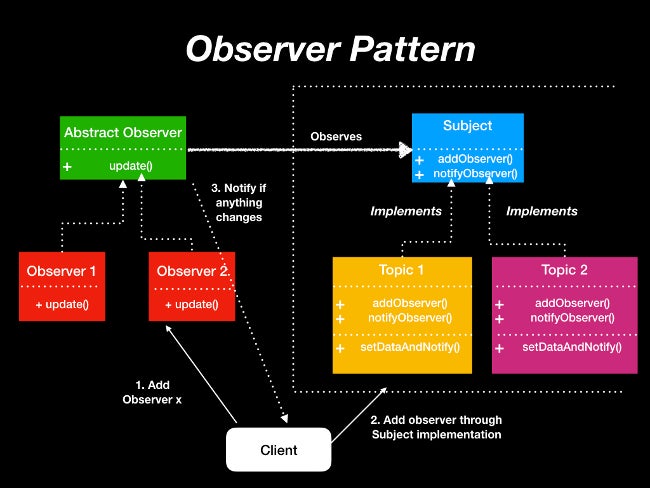
Observer Design Pattern
Whenever any new message will be posted to the topic, all the registers observers will be notified and they can consume the message. Based on the requirements of Subject, here is the base Subject interface that defines the contract methods to be implemented by any concrete subject. The typical application cases include GUIs (graphical user interfaces), which provide users with an easy-to-use interface for communicating with software. As soon as data is changed, these changes have to be updated in all GUI components – a scenario ideally covered by the subject/observer structure of the observer pattern.
Structural Software Design Patterns in C++
‘ConcreteObserver’ is an implementation of the ‘Observer’ interface. This can be prevented if the subject holds weak references to the observers. You can often experience this problem when working with classes of the graphical user interface. For example, you created custom button classes, and you want to let the clients hook some custom code to your buttons so that it fires whenever a user presses a button. Command encapsulates requests as objects, allowing parameterization and queuing of requests.
Important Topics for the Observer Pattern in C++ Design Patterns
Hiding in plain sight: activists don camouflage to beat Met surveillance - The Guardian
Hiding in plain sight: activists don camouflage to beat Met surveillance.
Posted: Sat, 01 Feb 2020 08:00:00 GMT [source]
By understanding and applying patterns such as Singleton, Factory, Observer, and others, you can improve the quality, scalability, and maintainability of your software projects. Subject is an object having methods to attach and detach observers to a client object. We have created an abstract class Observer and a concrete class Subject that is extending class Observer.
What are the advantages and disadvantages of the observer design pattern?
Even programs that work with datasets to be visualized (whether classic tables or graphic diagrams) also benefit from the design pattern structure. The observer design pattern – often abbreviated to observer pattern – is one of the most popular pattern templates for designing computer software. It provides a consistent way to define a one-to-one dependency between two or more objects in order to relay all changes made to a certain object as quickly and simply as possible. For this purpose, any objects that act as observer in this case can register with another object. The latter object – referred to as a subject – informs the registered observers as soon as it has changed.
Some things to keep in mind when implementing the observer pattern:
In that way, our lower layer can make calls to the upper layer without relying on specific implementation details. However, in principle the observer pattern can also be used for just one observing object. The ‘update’ method is called whenever the observed object’s state changes. Design Patterns are the solutions to commonly occurring problems in software design. They are like pre-fabricated blueprints that we can customize to solve a recurring design problem in your code.
Mastering Design Patterns
This push behavior is very convenient for handling asynchronous data streams, like user input or incoming network messages, and made this paradigm especially popular in front-end or web development. The facade design pattern, facade pattern in short, plays an important role in object-oriented software development. The pattern offers an elegant way to merge different interfaces of sub-system classes and develop software more flexibly and in a less complex manner. Find out what this entails and what its advantages and disadvantages are using facade pattern examples. In terms of the programming language used, there are no specific restrictions in principle for the observer design pattern.
In this example, the WeatherStation class is the subject, and PhoneDisplay and TVDisplay are the observers. When the WeatherStation's temperature changes, it calls the `notifyObservers()` method, which calls the `update()` method on each observer. The observers then update their temperature display accordingly. Imagine having a toolbox of tried-and-true solutions readily available.
In contrast, the Observer pattern focuses on subscription-based notifications without encapsulating requests. Whenever a user sends a message, all other users within the chat, acting as observers, will receive and display the message. While this approach keeps the observer interface small, comparing the current state with the new one to identify the changes can be challenging and time-consuming. Remember that our dependency rule applies only to implementation types at compile time.
A knitwear designer spins a yarn to create a colourful new home - The Guardian
A knitwear designer spins a yarn to create a colourful new home.
Posted: Sun, 21 May 2023 07:00:00 GMT [source]
Maybe you want certain components to get notified whenever certain data has finished downloading, or whenever users sent new messages to a message board and all other members should get notified. These functions will eventually receive data from the notify method. Today, most applications are implemented in layers to separate the business logic from other concerns like user interface or infrastructure code. Notice the implementation of update() method where it’s calling Subject getUpdate() method to get the message to consume.
The customer could visit the store every day and check product availability. But while the product is still en route, most of these trips would be pointless.
In other scenarios, tightly coupled objects can be a better option because the compiler is able to detect errors at compile time and optimize the code at the CPU instruction level. It is often used for implementing distributed event-handling systems in event-driven software. Design patterns are reusable solutions to common problems that arise during software development. They provide a shared vocabulary and best practices for designing scalable and maintainable software systems. In this article, we'll explore some of the most popular design patterns, including Singleton, Factory, Observer, and others. By understanding and applying these patterns, you'll be better equipped to tackle complex software development challenges.
Strategy patterns support object-based programming with a design pattern specialized in the behavior of software. By outsourcing code elements, independent strategies emerge that can be reused and exchanged with other solution methods at any time. When applying strategy design patterns, developers utilize proven know-how. Observer is a behavioral design pattern that lets you define a subscription mechanism to notify multiple objects about any events that happen to the object they’re observing.



No comments:
Post a Comment